Why Complexity Collapsed: When Attention Debt Pushes Societies Past the Complexity Ceiling

Historical visualization showing civilizational complexity ceiling pattern across Roman Colosseum administrative collapse, Mayan pyramid urban abandonment, and medieval governance fragmentation transitioning to modern networked world with declining capacity graph, demonstrating how societies collapse when operational complexity exceeds collective cognitive capacity to sustain coordination regardless of knowledge or resources available

The Hidden Limit That Determines How Advanced a Civilization Can Be Every civilization operates within invisible constraints determining maximum achievable complexity. These limits are not technological, economic, or ideological. They are cognitive: the collective capacity to maintain, coordinate, and operate systems requiring sustained multi-variable reasoning across time. When environmental conditions degrade this capacity below thresholds Why Complexity Collapsed: When Attention Debt Pushes Societies Past the Complexity Ceiling
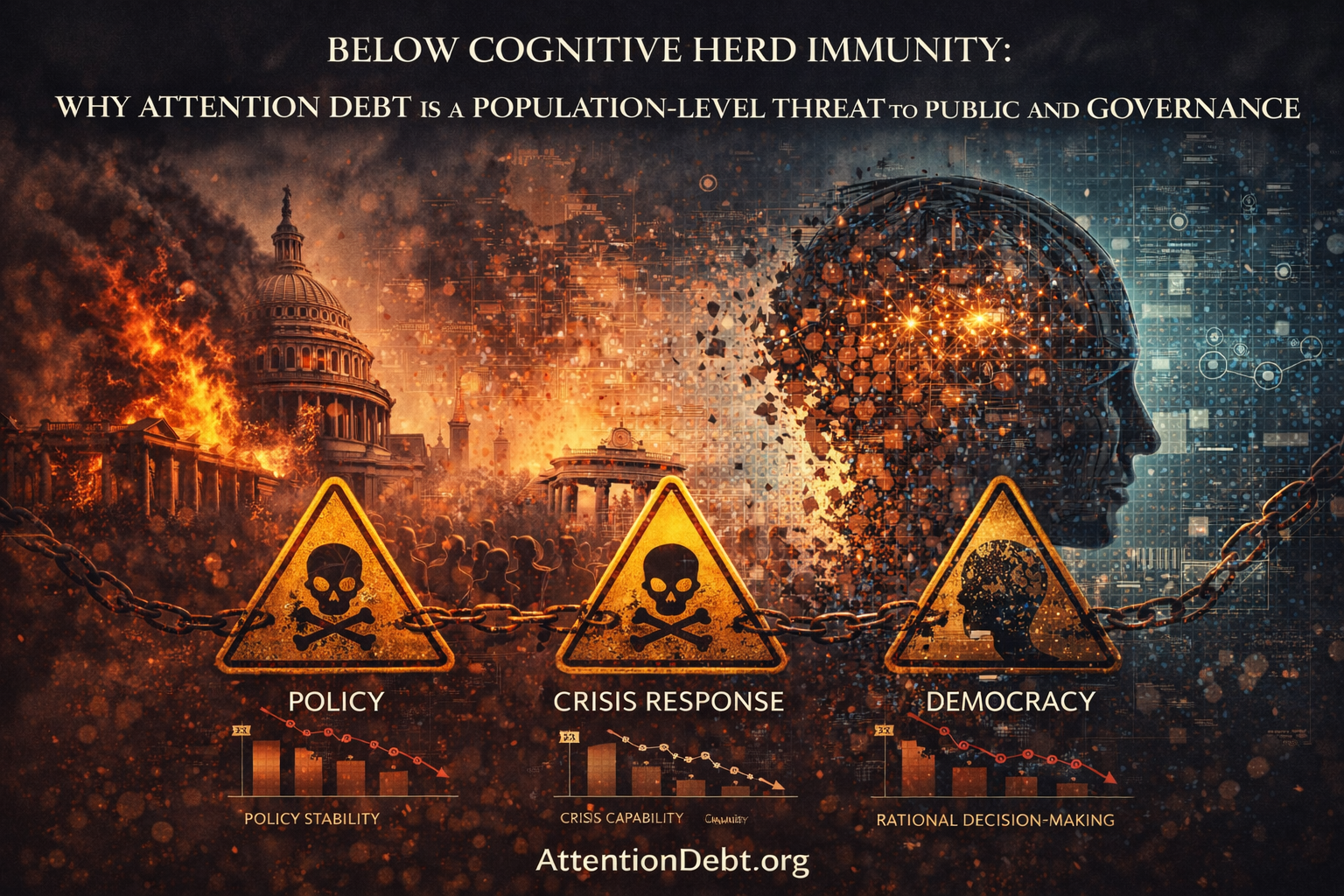
Below Cognitive Herd Immunity: Why Attention Debt Is a Population-Level Threat to Public Health and Governance

Visualization showing three hazard warning symbols representing governance functions threatened by population-level cognitive capacity degradation: policy stability, crisis response capability, and democratic rational decision-making, with declining threshold graphs below each symbol and fragmenting Capitol building transitioning to fragmenting human head demonstrating how environmental fragmentation creates below-threshold conditions

The Threshold Nobody Measures Public health systems track disease prevalence, mortality rates, life expectancy, vaccination coverage, and countless biological indicators across populations. These metrics reveal whether populations remain healthy enough to function, work, reproduce, and maintain social structures. But no public health system systematically tracks whether populations retain sufficient collective cognitive capacity to understand complex Below Cognitive Herd Immunity: Why Attention Debt Is a Population-Level Threat to Public Health and Governance

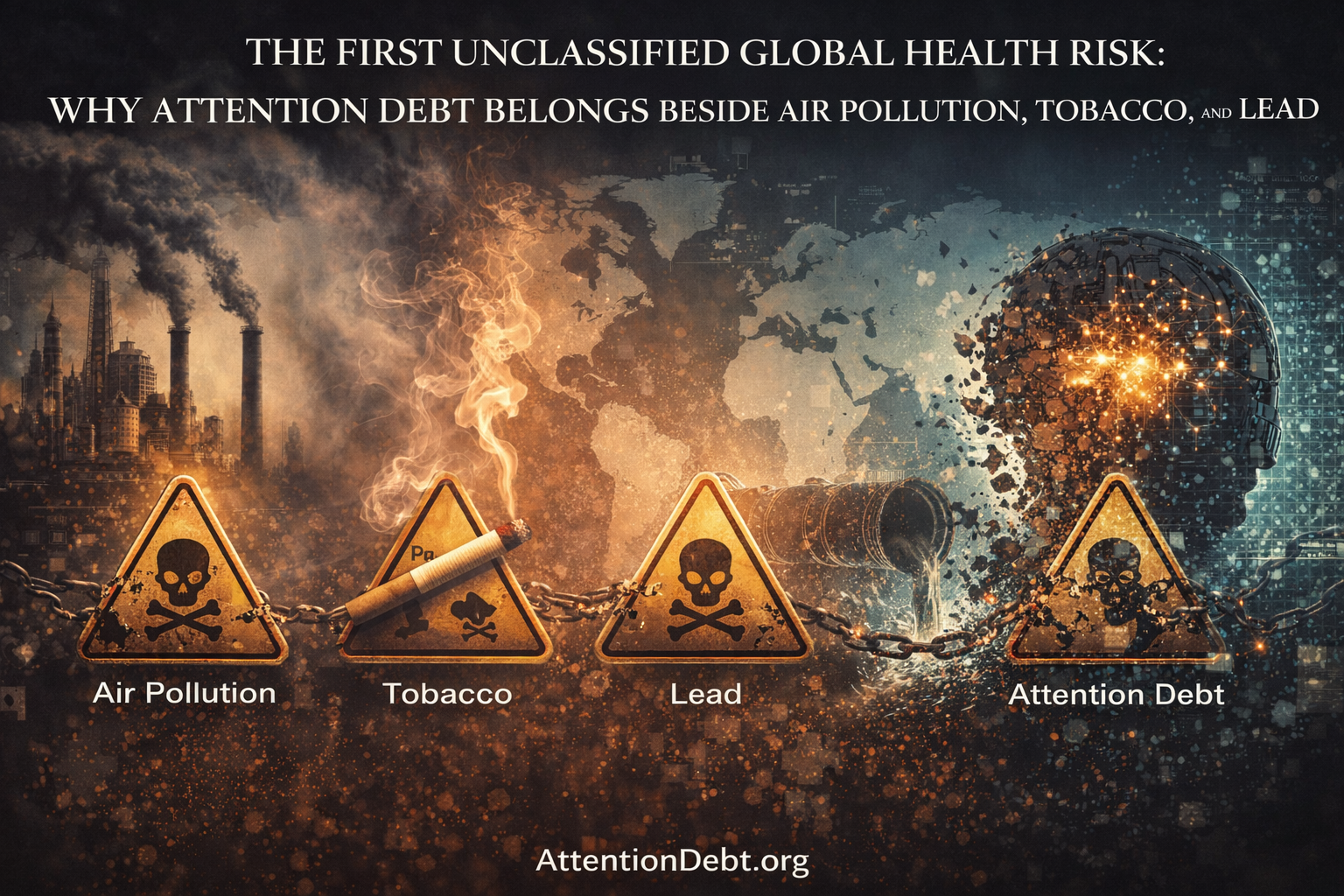
The First Unclassified Global Health Risk: Why Attention Debt Belongs Beside Air Pollution, Tobacco, and Lead

Four hazard warning symbols showing established WHO-classified global health risks (air pollution, tobacco, lead) alongside unclassified cognitive fragmentation risk attention debt, with world map background indicating population-scale environmental exposure requiring public health framework recognition

The Category That Doesn’t Exist The World Health Organization maintains comprehensive frameworks for identifying, measuring, and responding to global health risks. Air pollution. Tobacco smoke. Alcohol consumption. Lead exposure. Occupational hazards. These risks share common characteristics enabling their recognition: they are measurable, population-scale, environmentally generated, and amenable to intervention through architectural modification rather than individual The First Unclassified Global Health Risk: Why Attention Debt Belongs Beside Air Pollution, Tobacco, and Lead
Attention Debt Is a Hidden Health Crisis: Why Civilization Is Getting Sicker Without Knowing Why
Visualization showing fragmented human figure on left representing cognitive breakdown from attention debt, transitioning to medical monitoring displays on right showing heart rate variability, brain inflammation markers, immune system dysregulation, metabolic stress indicators, and cortisol levels demonstrating how environmental fragmentation creates measurable biological health consequences

The Pattern Nobody Connected Across developed nations, a disturbing pattern has emerged over the past fifteen years. Rates of conditions once considered rare or age-related are rising dramatically in populations that should be healthier than ever. Autoimmune diseases have increased 50% since 2010. Clinical anxiety and depression diagnoses have tripled. Metabolic dysfunction affects populations decades Attention Debt Is a Hidden Health Crisis: Why Civilization Is Getting Sicker Without Knowing Why

When AI Can Fake Everything, Proof of Existence Must Become a Constitutional Right

Double collapse visualization showing fragmenting human representing attention debt internal collapse on left, perfect digital human representing AI synthesis external collapse on right, broken causal chains between them, cryptographic verification shield protecting cascade network infrastructure below

The Scenario That Reveals Everything December 2029. A hiring manager reviews two candidates. Candidate A presents impressive credentials: prestigious university, recognized companies, detailed work history, glowing recommendations. Every signal suggests capability. Candidate B presents a ContributionGraph: 73 verified capability cascades across 6 years, branching through 380 people, with 68% persistence after 3 years and mathematical When AI Can Fake Everything, Proof of Existence Must Become a Constitutional Right

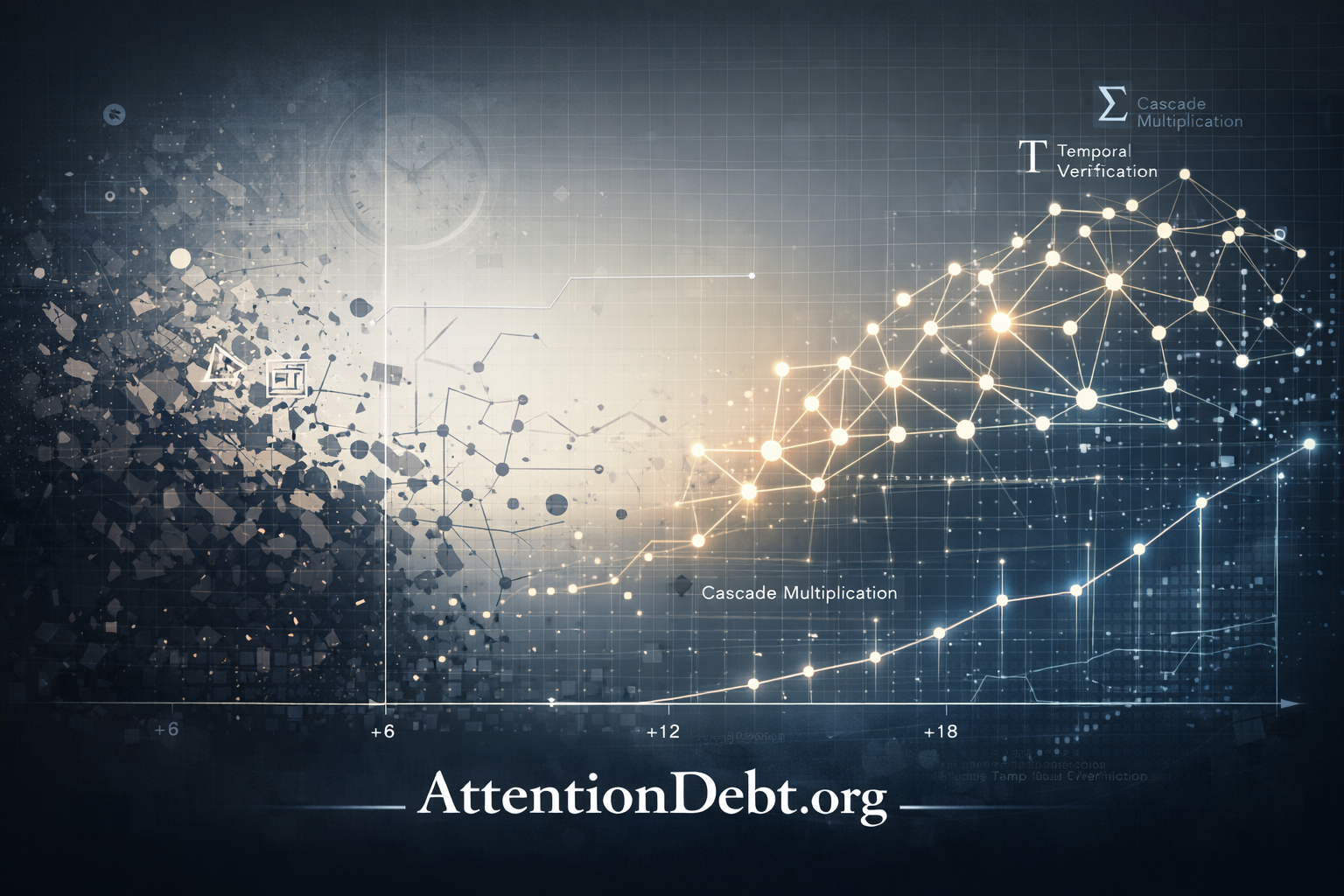
Why Attention Debt Forces Reciprocity to Become Verifiable or Disappear

Visualization showing attention debt fragmenting cognitive infrastructure on left, transitioning through temporal verification to cascade multiplication network on right with exponential growth curve over 18 months

The Collapse Nobody Named Something fundamental broke in human civilization between 2010 and 2025, but we lacked the language to describe what disappeared. People still helped each other. Transactions still occurred. Social bonds persisted. Yet something deeper—an infrastructure that once carried human cooperation across time—silently collapsed. That infrastructure was reciprocity: the ability of societies to Why Attention Debt Forces Reciprocity to Become Verifiable or Disappear

Attention Debt Is Not a Crisis — It Is an Accounting Error

Visualization of attention debt as accounting error showing engagement signals versus unverified capability gains with insolvency stamp on ledger and verified contribution solution

How Routing Value to Signals Instead of Verified Contribution Created Civilization-Scale Insolvency Attention debt is typically discussed as psychological crisis, platform manipulation, or cultural decay. Commentators describe users as addicted, platforms as predatory, society as fragmenting under digital pressure. These framings, while capturing real phenomena, miss the structural problem underneath. Attention debt is not fundamentally Attention Debt Is Not a Crisis — It Is an Accounting Error

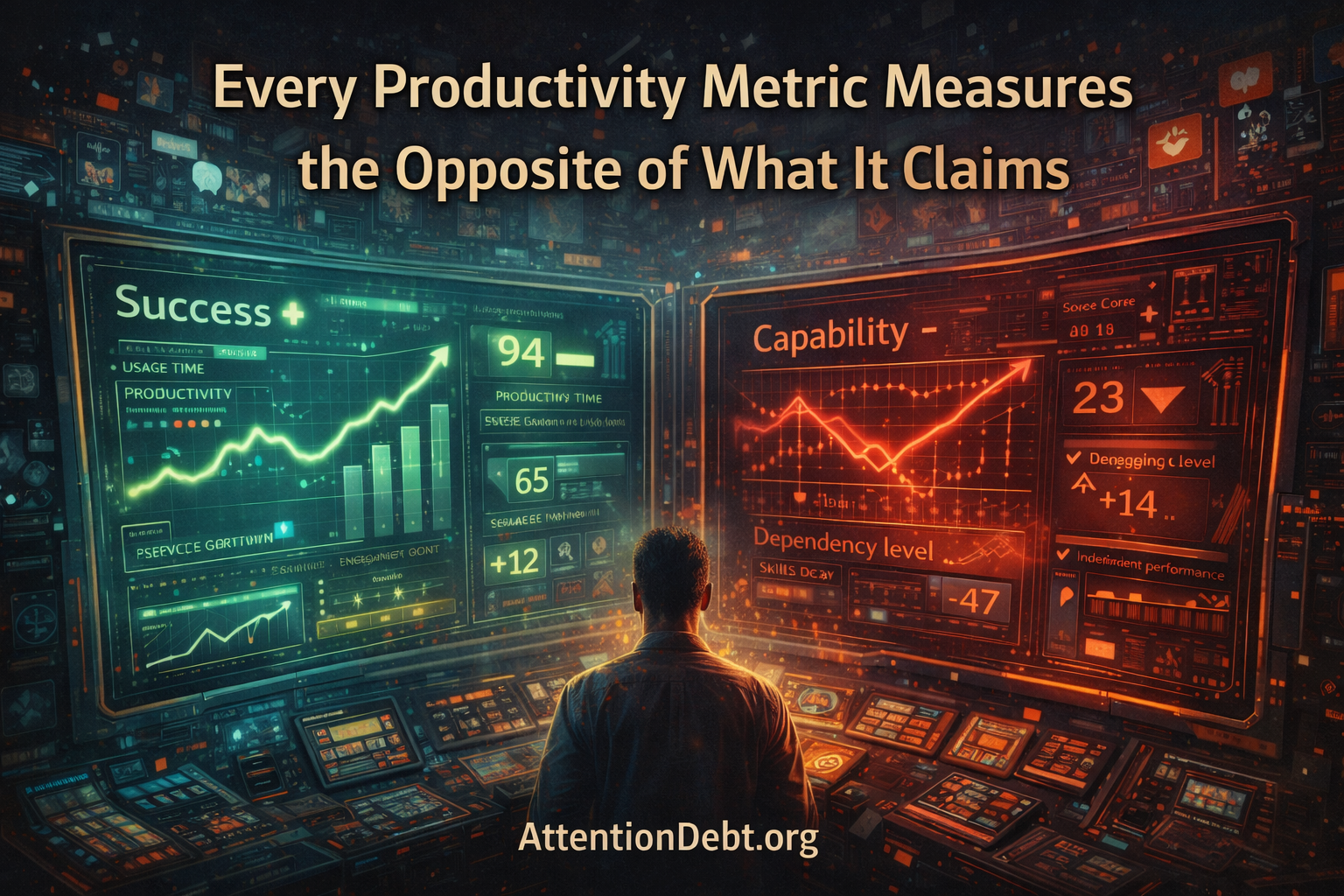
Every Productivity Metric Measures the Opposite of What It Claims

productivity-metric-inversion.webp

When output rises while capability to produce that output independently collapses, we call it ”productivity growth.” We should call it ”dependency acceleration.” Current measurement infrastructure systematically inverts success and failure. I. The Inversion Nobody Measured Every dashboard shows success. Productivity rising. Efficiency improving. Output accelerating. Time-to-completion decreasing. Error rates falling. Customer satisfaction increasing. Employee performance Every Productivity Metric Measures the Opposite of What It Claims

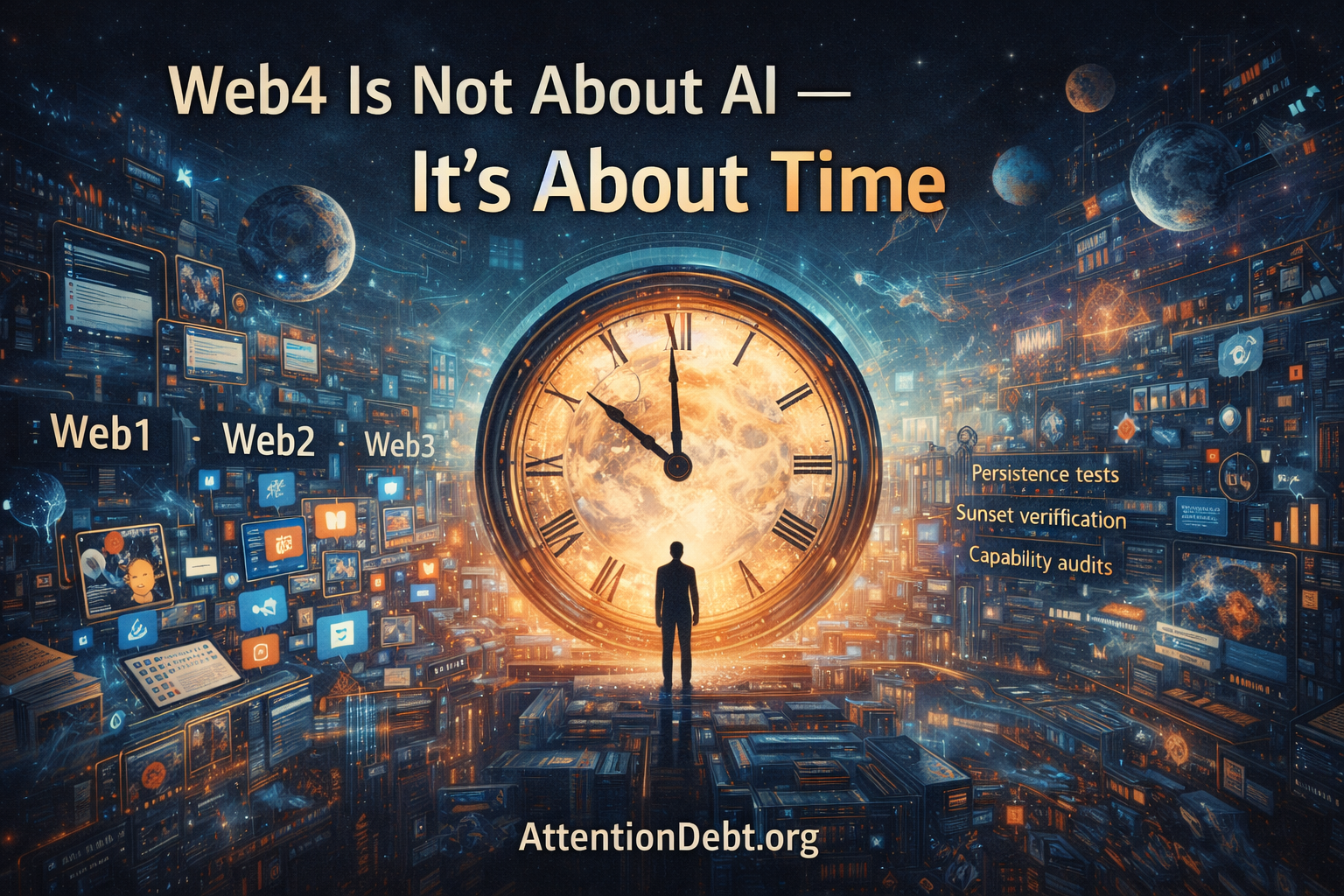
Web4 Is Not About AI — It’s About Time

Lone figure facing massive clock representing Web4 temporal verification layer with Web1, Web2, Web3 infrastructure visible and terms "Persistence tests," "Sunset verification," "Capability audits" showing measurement infrastructure

The next evolution of the internet is not smarter systems. It is systems that can verify whether anything endured. I. The Definition Nobody Has Every technological transition gets named before it gets defined. ”Web3” became ubiquitous while meaning everything and nothing – blockchain, crypto, decentralization, ownership, NFTs, DAOs – each advocate claiming their vision as Web4 Is Not About AI — It’s About Time

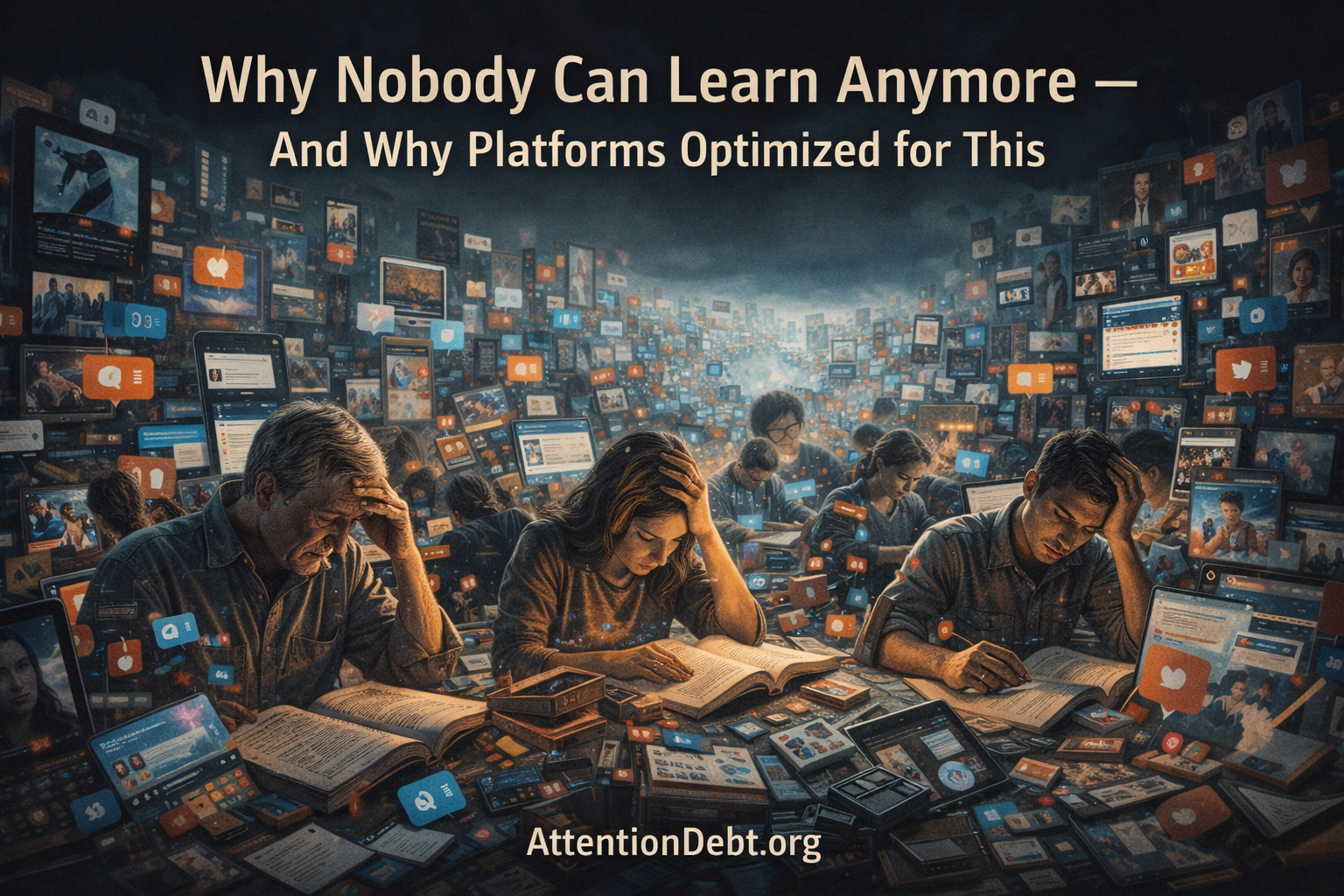
Why Nobody Can Learn Anymore — And Why Platforms Optimized for This

Split brain visualization showing fragmented attention patterns on left (scattered neural connections, notifications, interruptions) versus deep focus capability on right (strong neural pathways, sustained concentration) representing Learning Debt and Attention Bankruptcy

The attention economy business model requires users never develop persistent capability. This is not accusation. This is structural analysis of how revenue optimization and learning persistence became mutually exclusive. I. The Learning Collapse Nobody Can Explain Something fundamental broke in how humans learn, and it happened before AI assistance became ubiquitous. Educators report students who Why Nobody Can Learn Anymore — And Why Platforms Optimized for This

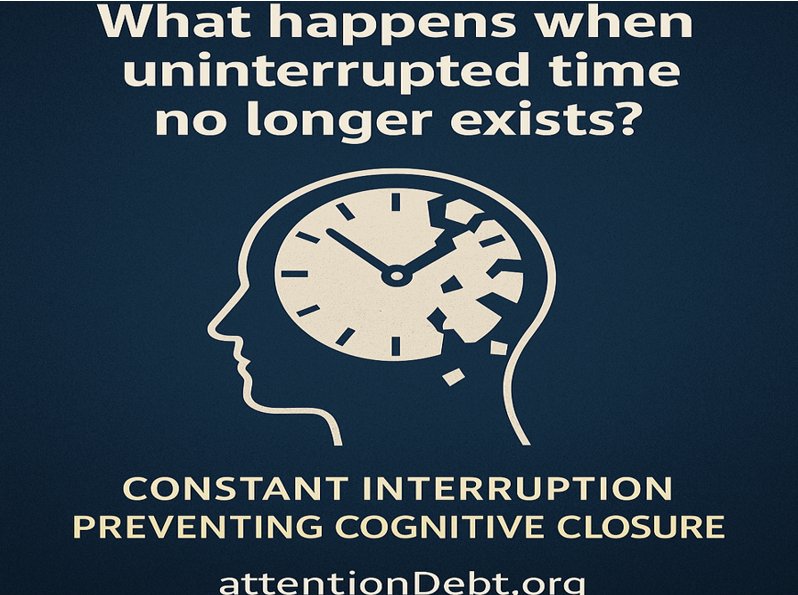
Why You Don’t Feel Like Yourself Anymore

A fragmented human silhouette with a cracked clock symbolizing attention debt and loss of temporal coherence.

The silent collapse nobody warned you about Sarah sits across from her therapist, struggling to answer a simple question: ”Tell me about yourself.” Not because she lacks intelligence. Not because she’s being evasive. Because she genuinely cannot assemble a coherent answer. The person she describes Monday bears no relationship to the person she describes Thursday. Why You Don’t Feel Like Yourself Anymore

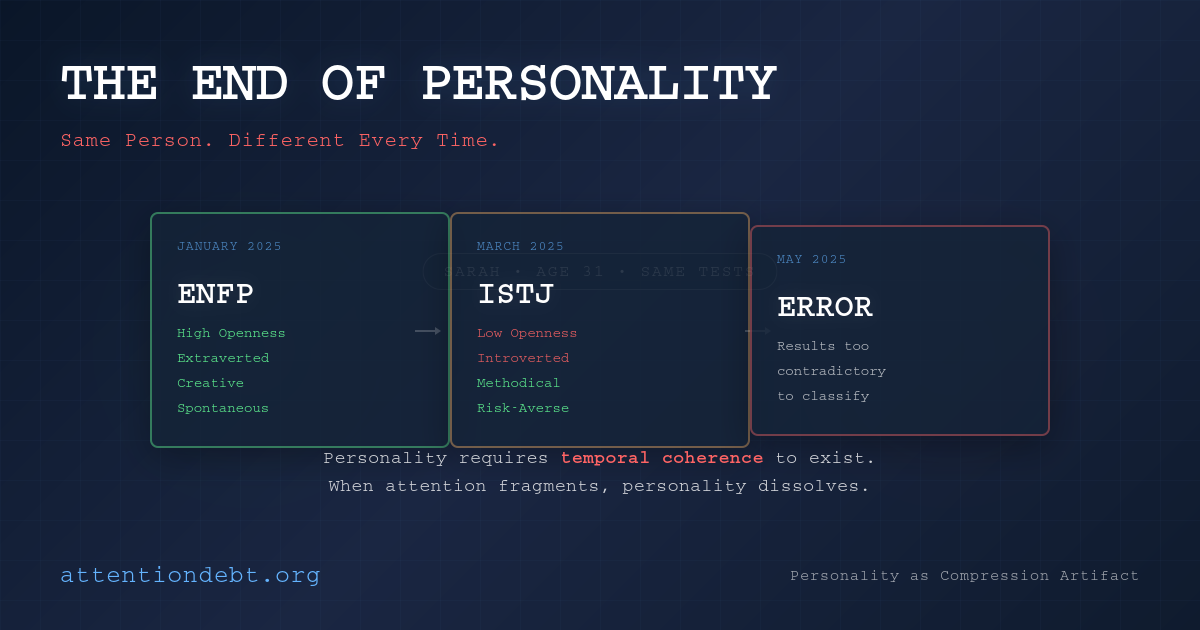
The End of Personality: When the Self Becomes Structurally Unobservable

Three personality test results for same person showing complete contradictions: ENFP in January, ISTJ in March, ERROR in May - visualizing how temporal coherence collapse makes personality structurally unmeasurable

Attention debt didn’t change personality. It made personality structurally impossible. Sarah takes personality tests monthly. Myers-Briggs, Big Five, Enneagram, every assessment her therapist suggests. The results change completely every time. January: ENFP, high openness, extraverted, creative, spontaneous. March: ISTJ, high conscientiousness, introverted, methodical, risk-averse. May: Results so contradictory the algorithms flag them as invalid. Her The End of Personality: When the Self Becomes Structurally Unobservable

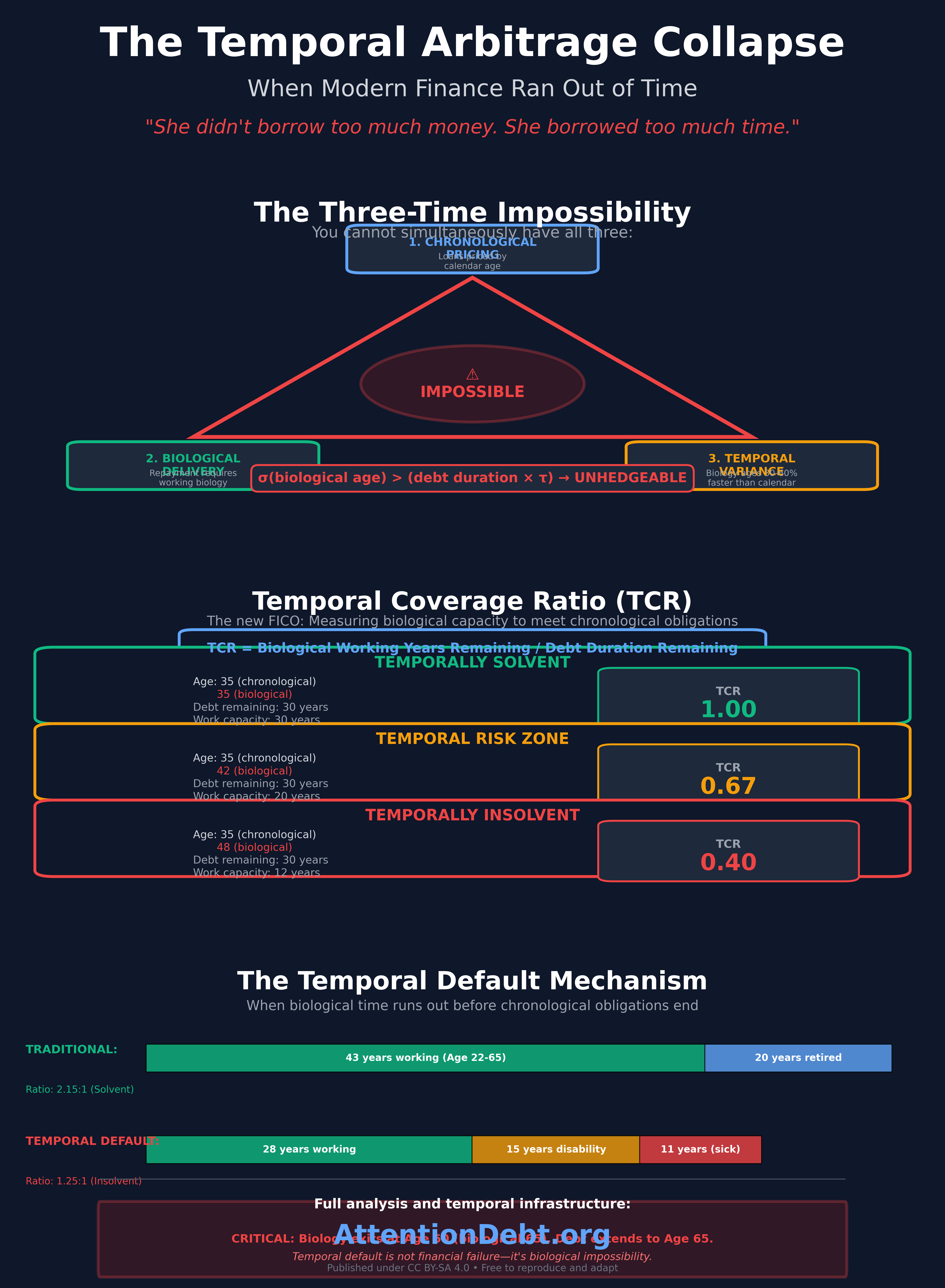
The Temporal Arbitrage Collapse: When Modern Finance Ran Out of Time

Three-Time Impossibility theorem triangle showing chronological pricing, biological delivery, and temporal variance cannot coexist - with Temporal Coverage Ratio calculator and timeline of temporal default at age 50

Every mortgage, bond, student loan, and insurance policy in the world is a bet on time staying predictable. Attention debt made time unpredictable. Trillions in obligations now rest on a temporal assumption that no longer holds. Maya is thirty-two years old. She has a thirty-year mortgage and $87,000 in student loans. Her payments total $2,840 The Temporal Arbitrage Collapse: When Modern Finance Ran Out of Time

The Chronological Insolvency Crisis: When Human Time Desynchronized

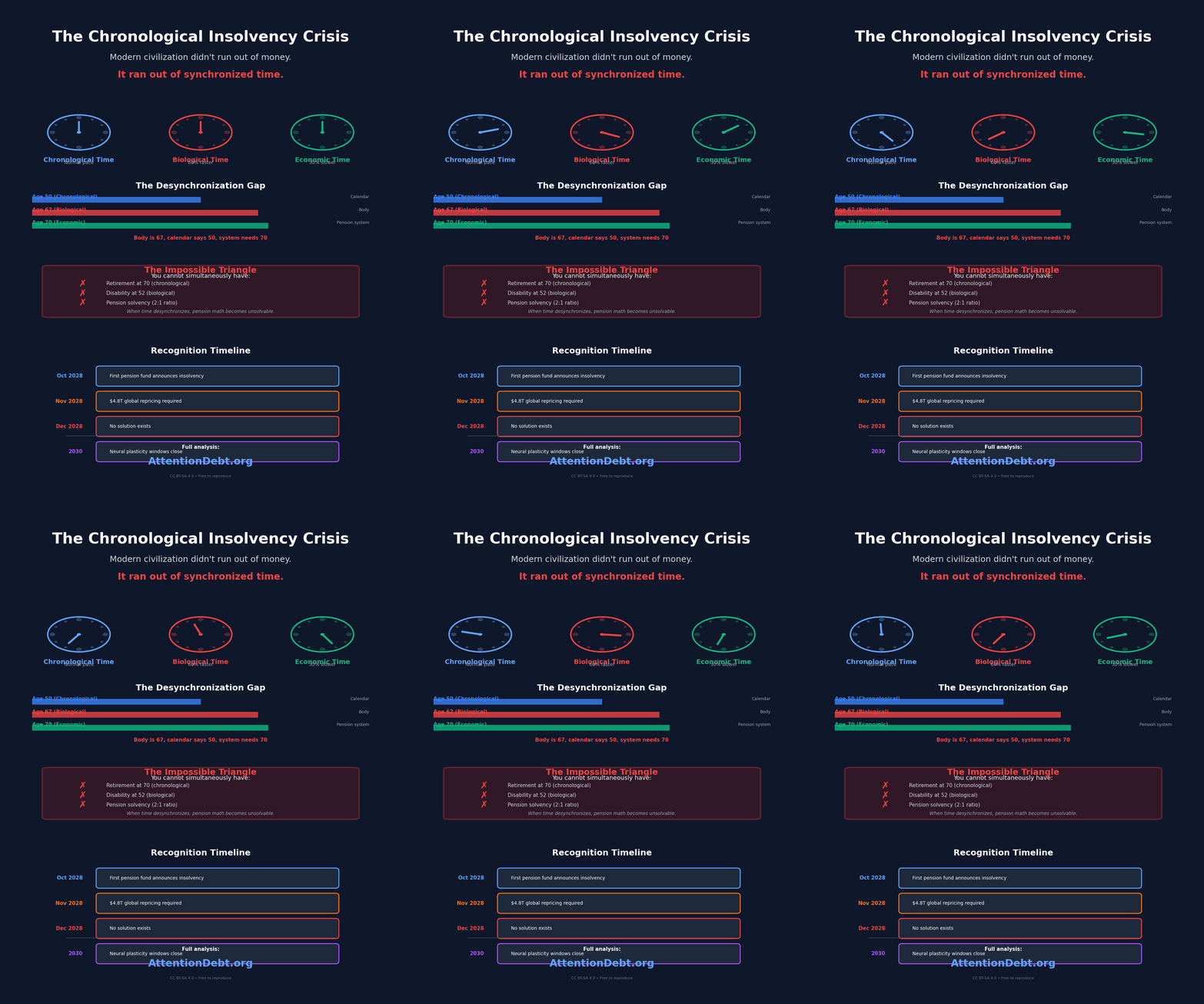
Three clocks showing biological age, chronological age, and economic time desynchronizing - chronological insolvency crisis visualization with pension collapse timeline to 2028

Modern civilization is built on a single assumption: biological age, economic value, and chronological time move together in predictable lockstep. Attention debt broke that synchronization. Everything built on synchronized time is now insolvent. Sarah is fifty-two years old. Her body is sixty-seven. The pension system needs her to work until seventy. She will die at The Chronological Insolvency Crisis: When Human Time Desynchronized

The Coordinated Collapse Hypothesis

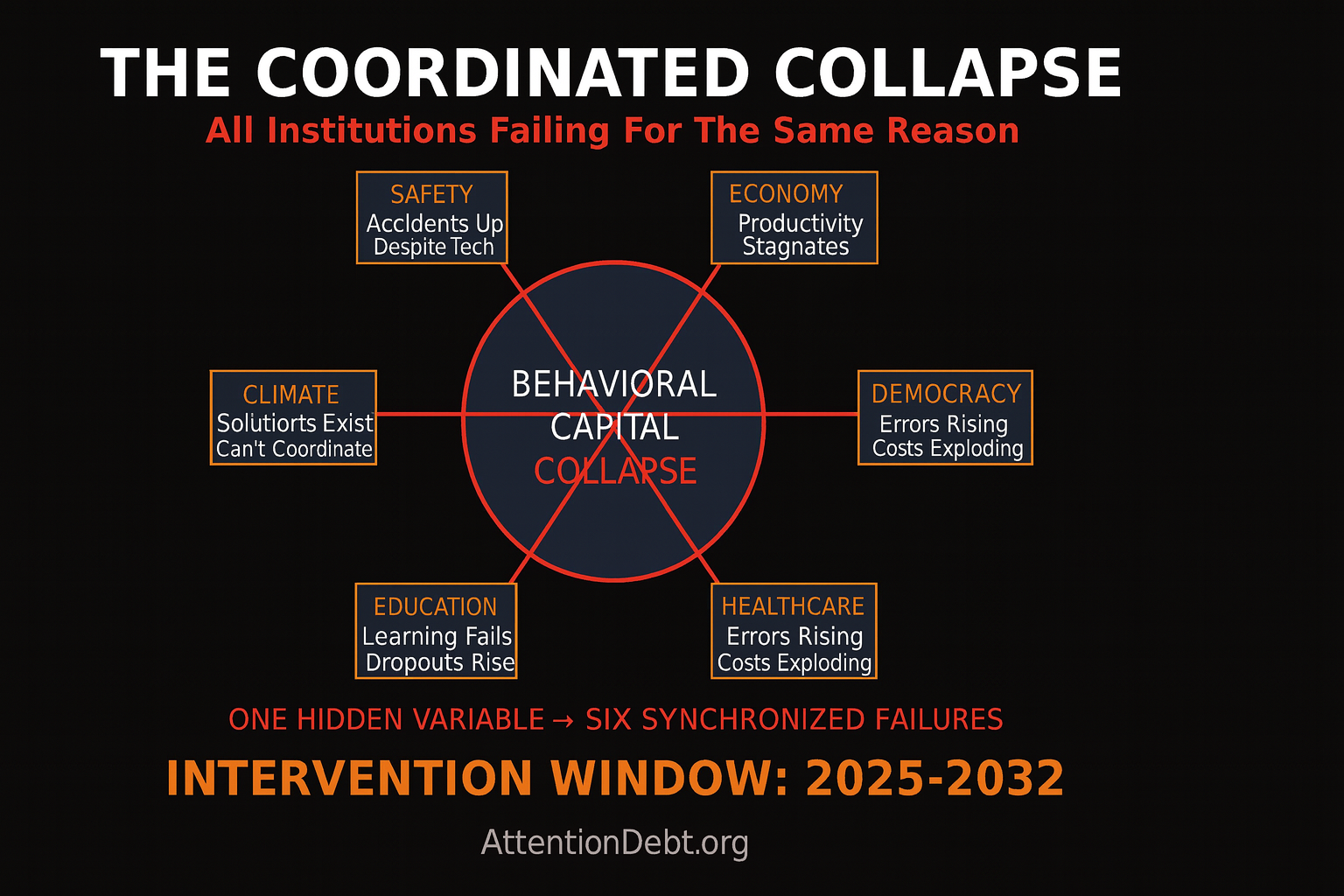
Coordinated collapse diagram showing six institutional failures (democracy, healthcare, education, climate, safety, economy) all connected to central behavioral capital collapse

Why No Institution on Earth Can Solve Any Problem Longer Than a News Cycle—And the Hidden Variable Making Them Fail Simultaneously TL;DR — The Pattern Nobody Can Explain Democracy is not failing. Healthcare is not failing. Education is not failing. Climate governance is not failing. Public safety is not failing. Economic coordination is not failing. The Coordinated Collapse Hypothesis

The Memory Generation

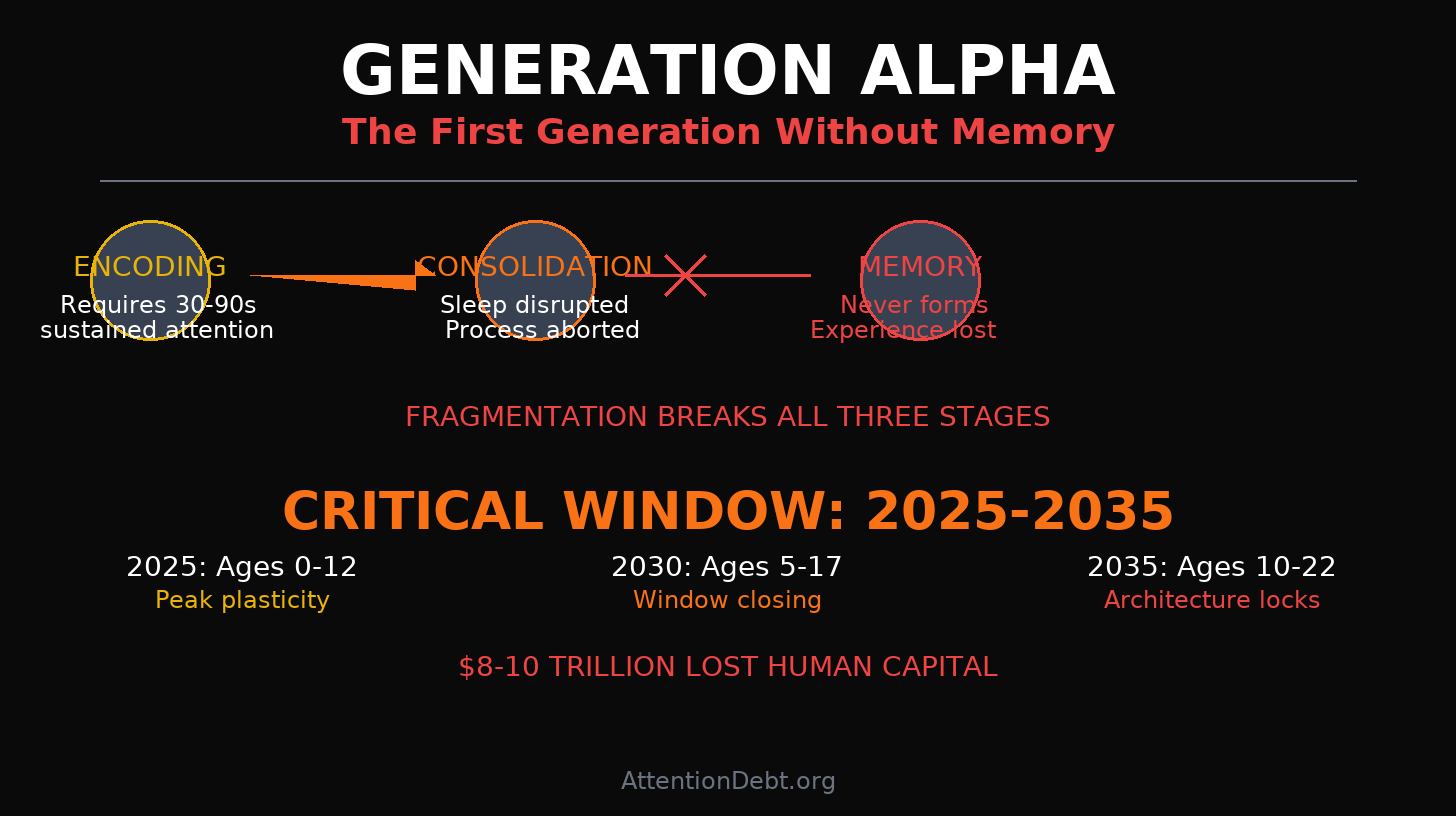
Generation Alpha memory formation failure showing three-stage process: encoding, consolidation, and memory formation all broken by attention fragmentation

Why Your Children Will Not Remember Their Childhood—And What That Costs TL;DR — The Neurological Reality Human memory formation requires sustained attention during experience and uninterrupted processing during sleep. Research on adult populations documents attention shifts occurring approximately every 47 seconds with 200-400 daily interruptions; developmental observations suggest similar fragmentation patterns emerging in child populations. The Memory Generation

The Extraction Ledger

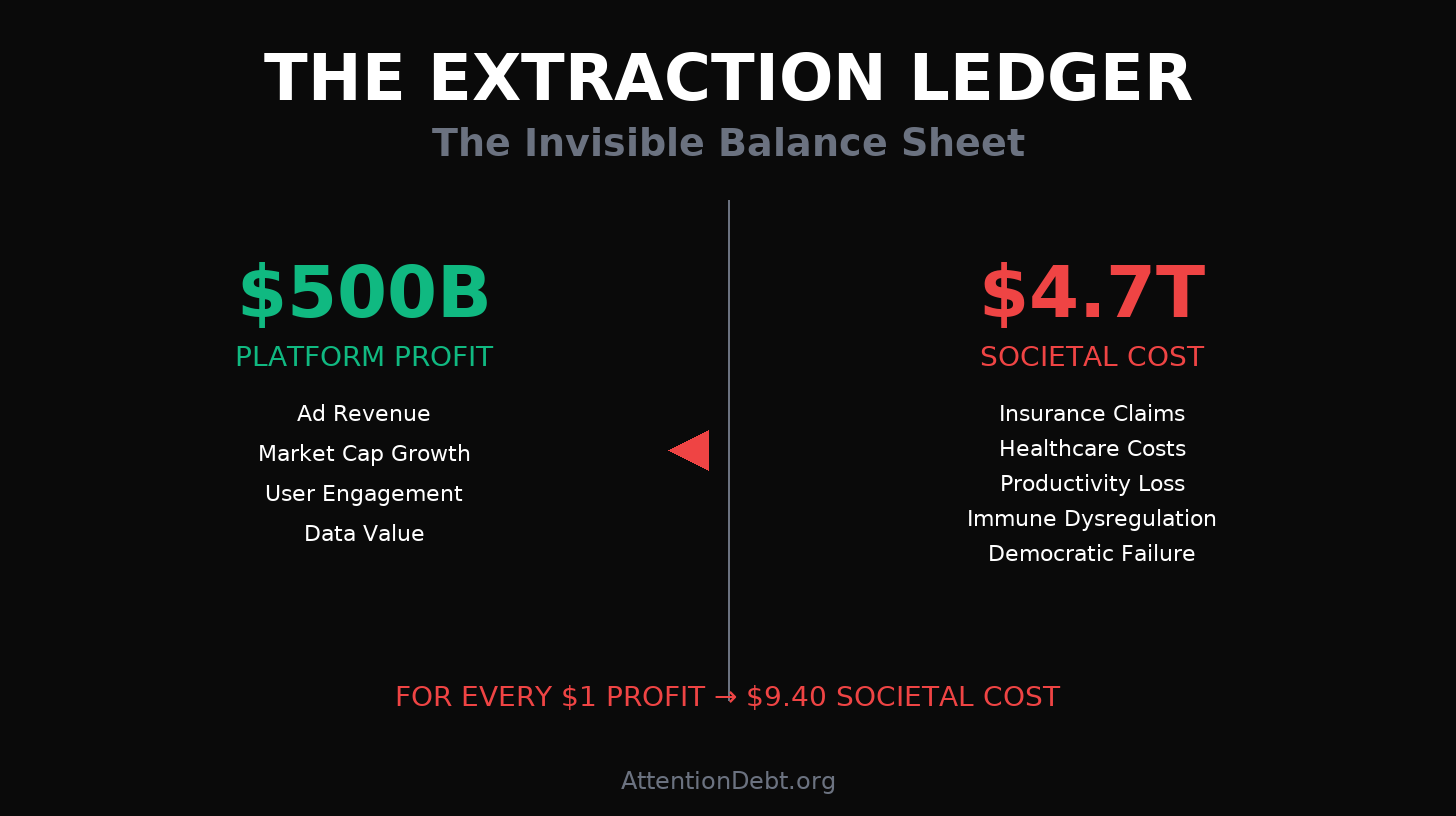
The Extraction Ledger showing $500B platform profit versus $4.7T societal cost from cognitive externalities

How Platforms Book Profit While Offloading Trillions in Cognitive Liability to Everyone Else TL;DR — The World’s Largest Unbooked Liability For every dollar of advertising revenue generated by engagement-optimizing platforms, the economic system absorbs between $8 and $15 in downstream costs. These costs—measured in insurance claims, healthcare utilization, lost productivity, and institutional failures—are never recorded The Extraction Ledger

The $4.3 Trillion Attention Collapse

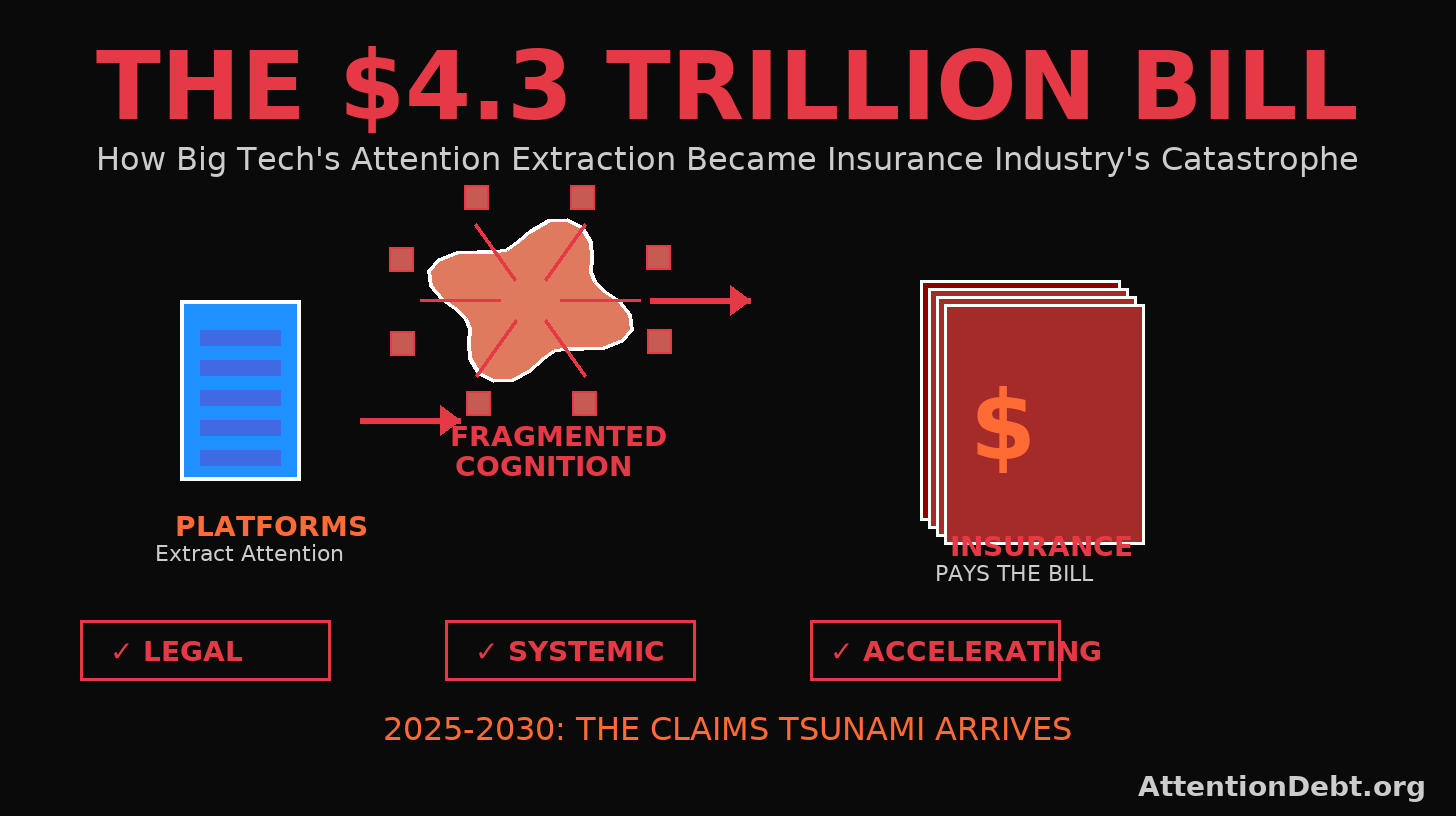
"Insurance industry $4.3 trillion liability from attention collapse - platforms extract attention, insurers pay claims visualization

Why the Global Insurance Industry Faces Its Largest Payout Crisis Since World War II—And Doesn’t Know It Yet TL;DR — The Hidden Insurance Catastrophe A massive, unmeasured liability is building in the global insurance system. Attention fragmentation—the collapse of sustained cognitive capacity across populations—is driving exponential increases in insurable events. The mechanism is simple: fragmented The $4.3 Trillion Attention Collapse

The Cognitive Immunity Crisis

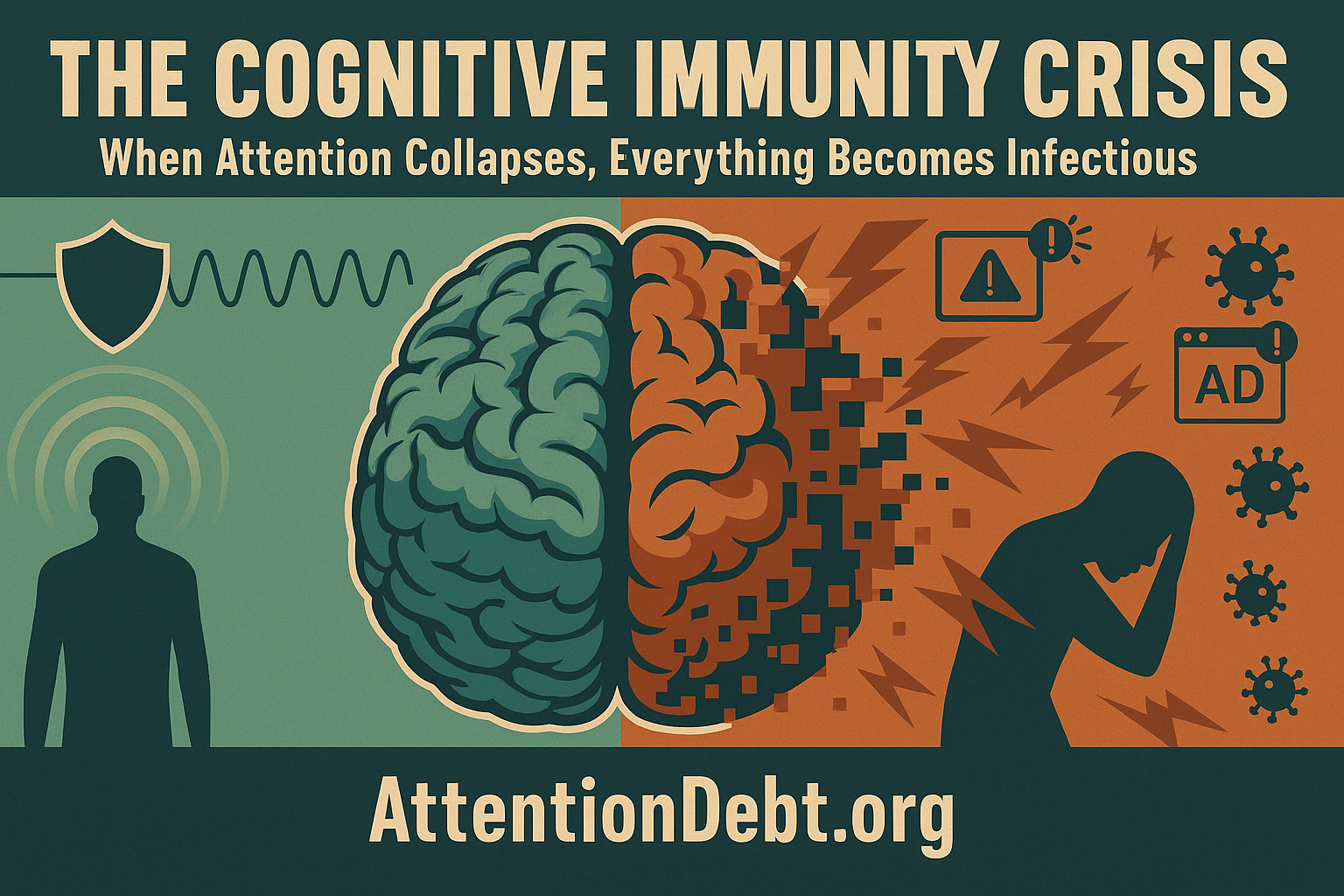
Cognitive and biological immune system collapse from attention fragmentation - immune load visualization illustration

How Humanity Lost Its Mental Immune System—And What Happens When Everything Becomes Infectious TL;DR — The Immunity Collapse in Five Points Your immune system—both biological and cognitive—depends on stable environmental signals. Attention fragmentation creates chronic instability that breaks this dependence. The cognitive-immune coupling is real. Your brain’s attention system sends threat signals to your immune The Cognitive Immunity Crisis

Your Children Will Not Remember You

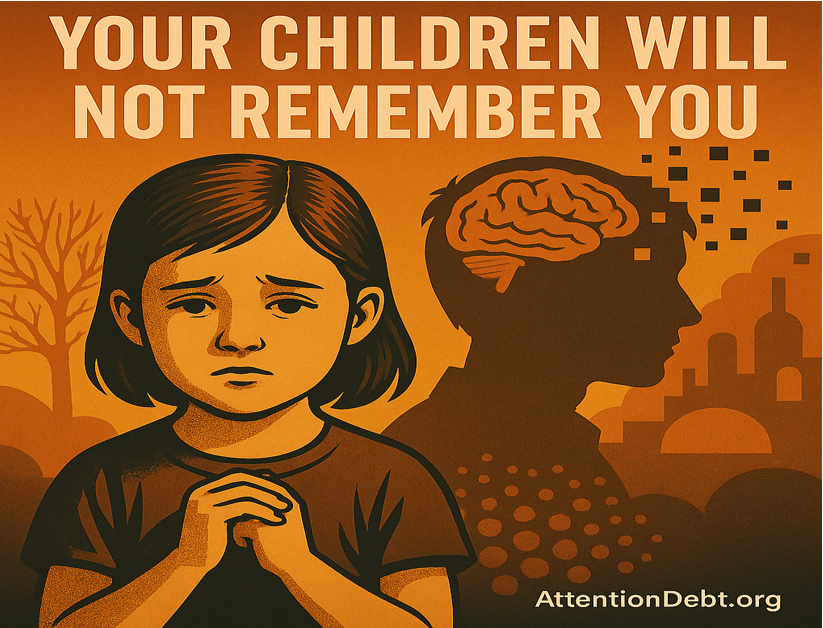
Child with fragmented attention unable to form long-term memories - Generation Alpha memory consolidation crisis illustration

The Memory Consolidation Crisis Creating the First Generation Without Long-Term Recall TL;DR — The Memory Crisis in Five Points Memory consolidation requires sustained attention during encoding. Without it, experiences never transfer to long-term storage—they simply disappear. Generation Alpha (born 2013-2025) is developing during unprecedented attention fragmentation. Early research shows concerning patterns: reduced hippocampal consolidation, impaired Your Children Will Not Remember You

The Great Cognitive Divergence: Two Human Species Are Emerging—And Only One Can Survive AI

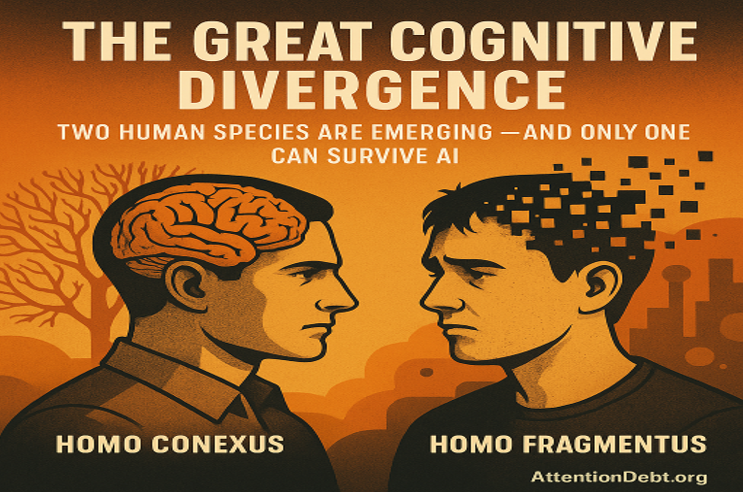
Homo Conexus with sustained attention brain vs Homo Fragmentus with fragmented cognition - cognitive speciation illustration

TL;DR — The Speciation in Five Points Humanity is splitting into two cognitive species. Not through genetics, but through attention. Homo Conexus (those who restored cognitive capacity) and Homo Fragmentus (those who didn’t). The split is biological. Measurable in neural plasticity, sustained attention capacity, memory consolidation. Two different brain architectures emerging from same genome. Age The Great Cognitive Divergence: Two Human Species Are Emerging—And Only One Can Survive AI

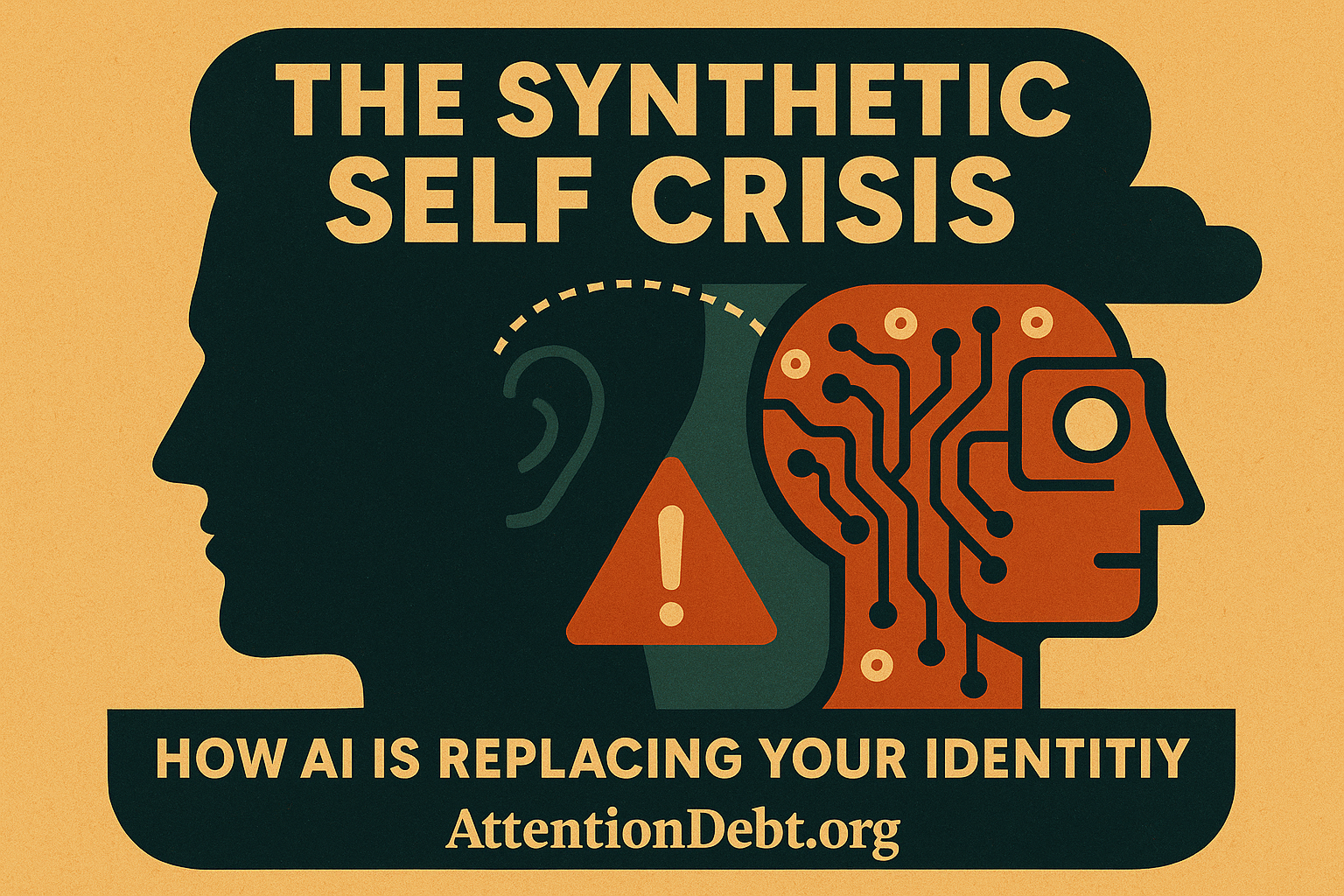
The Synthetic Self Crisis: How AI Is Replacing Your Identity Before You Notice You’ve Lost It

Synthetic Self Crisis illustration showing AI replacing human identity - digital twin becomes more authoritative than biological self through attention debt and platform ownership

TL;DR — The Identity Replacement in Five Points AI doesn’t just assist—it replicates. Your digital twin already exists in training data. It knows your patterns, mimics your voice, writes like you. Soon it will know your friends better than you do. Attention debt made you replaceable. Fragmented cognition means you can’t maintain relationships, remember context, The Synthetic Self Crisis: How AI Is Replacing Your Identity Before You Notice You’ve Lost It

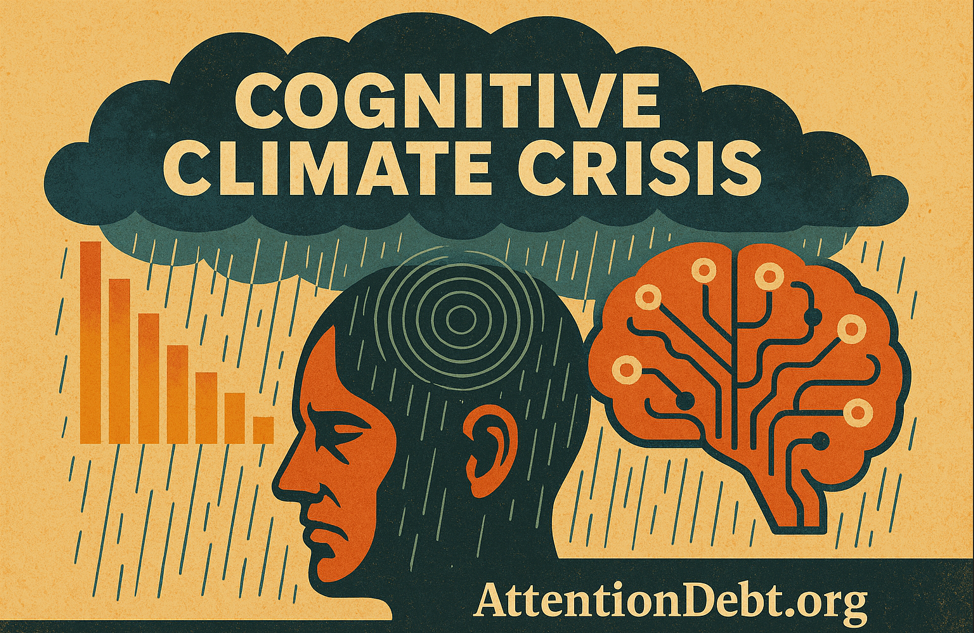
The Cognitive Climate Crisis: Humanity Is Running Out of Attentional Oxygen

Cognitive Climate Crisis illustration showing human head with storm clouds, declining bar chart representing attention capacity loss, and neural network brain symbolizing 2007-2025 atmospheric degradation

TL;DR — The Crisis in Five Points Attention is not a resource—it’s a biosphere. Like Earth’s atmosphere, the cognitive climate has specific conditions required for higher thought to survive. Those conditions are collapsing. Notifications are emissions. Every ping, scroll, and feed refresh pumps cognitive pollutants into your neural atmosphere. We’ve increased cognitive emissions 10,000% since The Cognitive Climate Crisis: Humanity Is Running Out of Attentional Oxygen

The Cognitive Debt Crisis: When Nations Go Bankrupt (And Your Children Inherit the Bill)

Generational cognitive debt transfer showing parent generation 50% capacity passing bankruptcy to child generation with $50 trillion bubble

Your children are inheriting a debt they didn’t create. Not financial debt—though that’s bad enough. Cognitive debt. The accumulated deficit of sustained attention capacity that your generation borrowed against and theirs will spend their entire lives trying to repay. Except they can’t. Because cognitive debt doesn’t work like financial debt. Financial debt: you borrow money, The Cognitive Debt Crisis: When Nations Go Bankrupt (And Your Children Inherit the Bill)

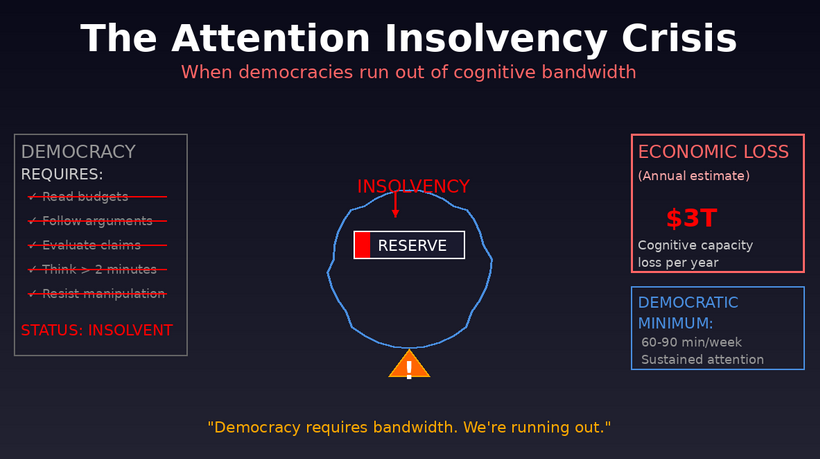
The Attention Insolvency Crisis: Why Democracies Are Collapsing (And Nobody Can Focus Long Enough To Notice)

Brain diagram showing depleted cognitive reserve meter with democracy requirements crossed out and $3 trillion economic loss from attention insolvency

Your government requires sustained thought to function. You can’t provide it anymore. Not because you’re broken. Because your cognitive reserve—the mental bandwidth required to think beyond immediate reaction—has been systematically extracted by systems optimized for engagement, not understanding. Democracy assumes citizens can read a budget. Follow an argument. Evaluate competing claims. Think for longer than The Attention Insolvency Crisis: Why Democracies Are Collapsing (And Nobody Can Focus Long Enough To Notice)

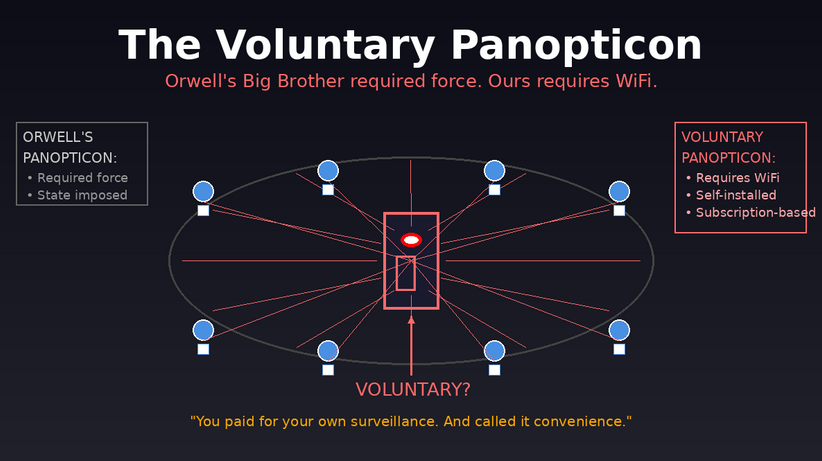
The Voluntary Panopticon: How Convenience Became Surveillance (And You Paid For It)

Diagram showing voluntary panopticon with smartphone as central guard tower and users self-surveilling through convenience features

Orwell’s Big Brother required force. Ours requires WiFi. In 1984, the Ministry of Truth watched citizens through telescreens installed by the state. Mandatory. Unavoidable. Totalitarian. In 2025, you installed the telescreen yourself. You pay a monthly subscription for it. You carry it everywhere. You panic when the battery dies. And you call it ”convenience.” Big The Voluntary Panopticon: How Convenience Became Surveillance (And You Paid For It)

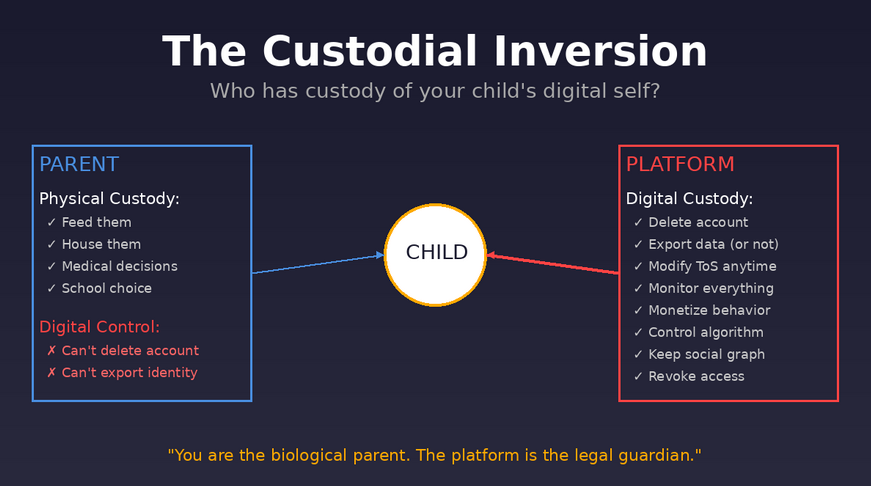
The Custodial Inversion: Who Has Legal Custody of Your Child’s Digital Self?

Visual diagram comparing parent physical custody versus platform digital custody control over child's online identity and data

You are the biological parent. The platform is the legal guardian of your child’s digital identity. Not metaphorically. Structurally. According to the contract you agreed to when you—or your child—created that account. You think you have custody because you’re the parent. You feed them, house them, make medical decisions, choose their school. Legal custody over The Custodial Inversion: Who Has Legal Custody of Your Child’s Digital Self?

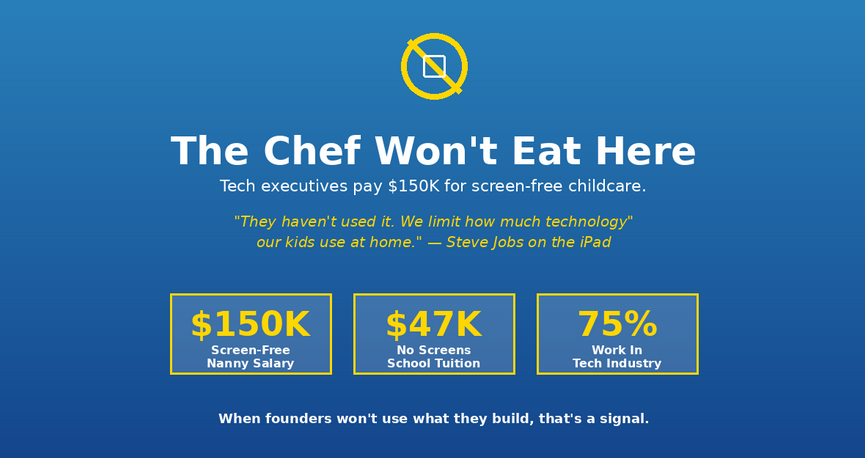
When The Chef Won’t Eat At His Own Restaurant: Why Tech Executives Pay $150,000 For Screen-Free Childcare

Screen-free childcare environment in Silicon Valley

Analytical Framework: This article examines publicly documented patterns in technology executive behavior, school enrollment data, salary information, and on-the-record statements. All observations are based on verifiable public information. This analysis applies standard venture capital evaluation frameworks to observed market behavior. No claims are made about internal company knowledge, undisclosed research, or unstated motivations. Patterns described When The Chef Won’t Eat At His Own Restaurant: Why Tech Executives Pay $150,000 For Screen-Free Childcare

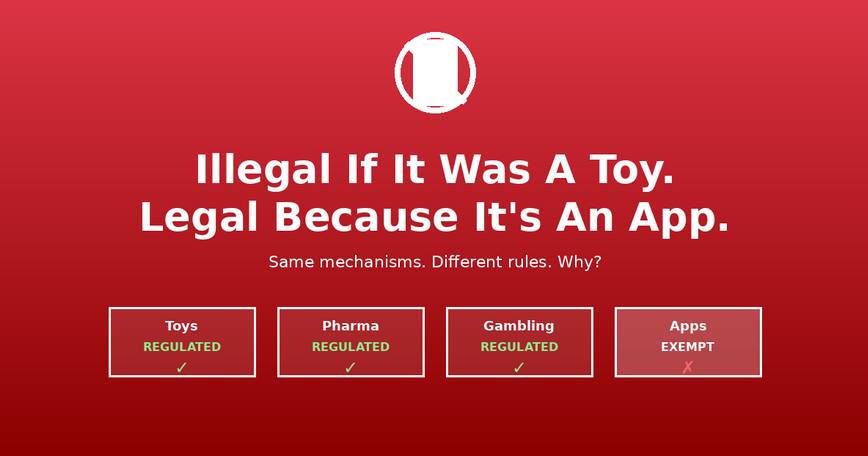
The Product That Would Be Illegal If It Wasn’t An App: How Engagement Optimization Bypasses Every Child Safety Standard By Calling Itself A Platform

Illustration showing how engagement algorithms are designed to maximize screen use in children.

We banned lead paint because it damages developing brains. Why are algorithms that target developing brains exempt from testing? Analytical Framework: This article examines existing child safety regulations across multiple product categories and compares documented features of engagement optimization systems to prohibited mechanisms in regulated industries. All observations are based on publicly available regulatory frameworks, The Product That Would Be Illegal If It Wasn’t An App: How Engagement Optimization Bypasses Every Child Safety Standard By Calling Itself A Platform

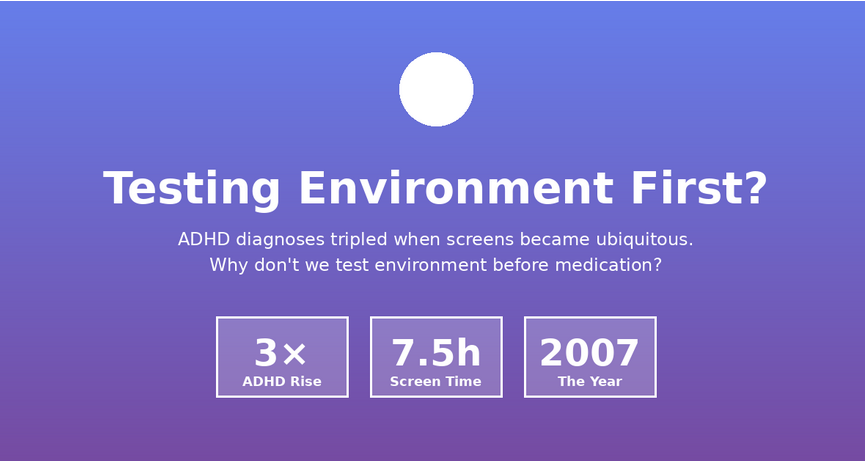
The Diagnosis We Give Without Testing The Environment First: What Happens When Attention Problems Appear In The Exact Generation We Optimized Everything To Fragment Attention

Infographic showing the correlation between rising ADHD diagnoses, increasing daily screen time, and the year smartphones became widespread, asking whether environment should be tested before medication.

We medicate children for attention deficits without ever testing if the environment is causing the deficit. Why? Analytical Framework: This article examines only publicly documented correlations between environmental changes, diagnostic patterns, and treatment protocols. It makes no claims about individual diagnoses, medication efficacy, or the validity of ADHD as a condition. It simply asks: when The Diagnosis We Give Without Testing The Environment First: What Happens When Attention Problems Appear In The Exact Generation We Optimized Everything To Fragment Attention

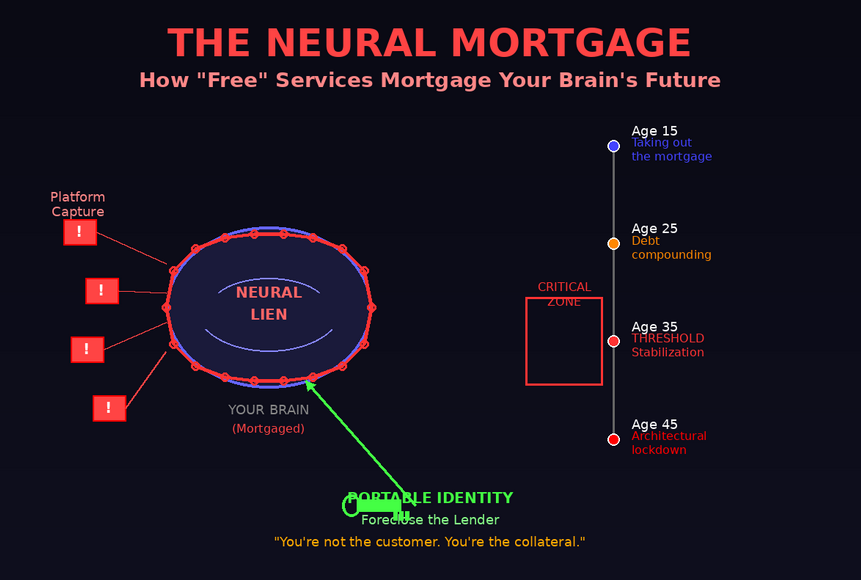
The Neural Mortgage: How ”Free” Services Are Mortgaging Your Brain’s Future (And Why the Bill Comes Due at 35)

Neural mortgage visualization showing brain with chains and age threshold timeline around 35

The Neural Mortgage: How ”Free” Services Are Mortgaging Your Brain’s Future (And Why the Bill Comes Due at 35) You think you’re getting free email, free social networking, free entertainment. You’re not. You’re taking out a mortgage on your brain’s future. And at age 35, the bank comes to collect. Not in money. In something The Neural Mortgage: How ”Free” Services Are Mortgaging Your Brain’s Future (And Why the Bill Comes Due at 35)

Attention Debt: The Bankruptcy Your Brain Doesn’t See Coming

Attention debt visualization showing fragmented neural pathways and notification overload

Attention Debt: The Bankruptcy Your Brain Doesn’t See Coming Can’t focus anymore? It’s not you — it’s attention debt. Attention debt is the neurological cost of the Web2 attention economy: where platforms profit by fragmenting your focus, and your brain literally rewires itself to prefer distraction over depth. In a contribution economy, attention isn’t just Attention Debt: The Bankruptcy Your Brain Doesn’t See Coming

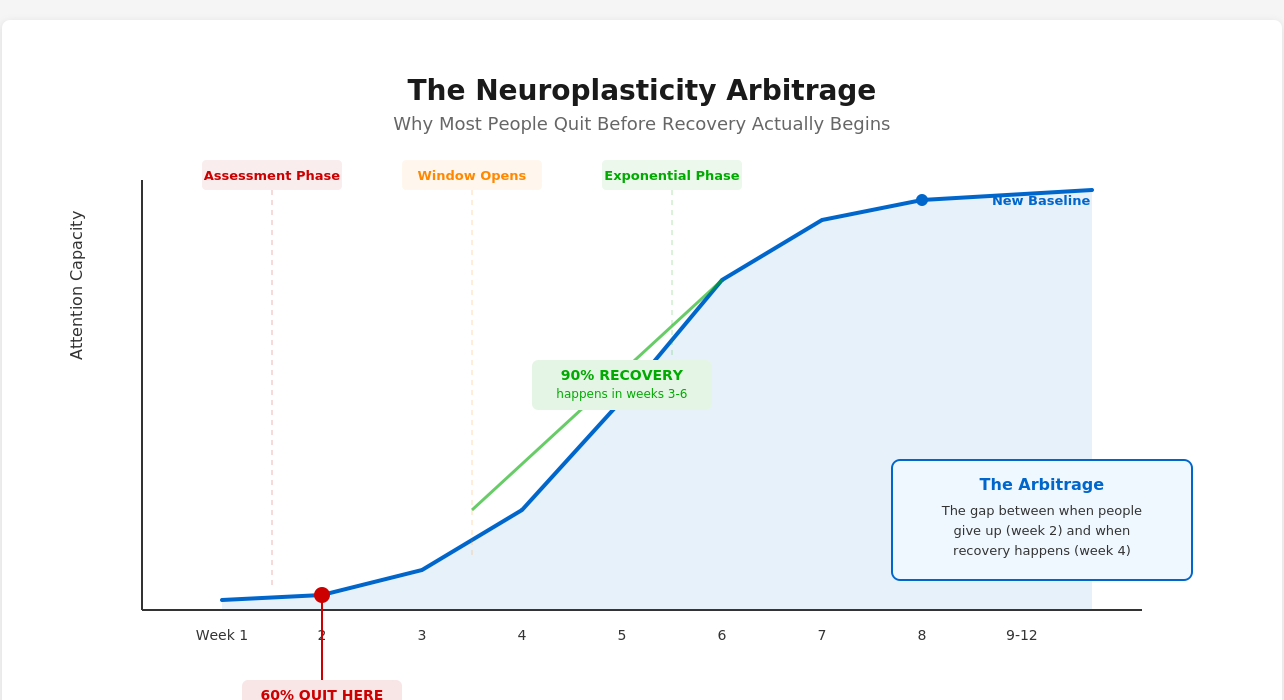
The Neuroplasticity Arbitrage: Why Your Attention Bankruptcy Is Reversible (But The Window Is Closing)

Timeline showing attention bankruptcy recovery phases: 60% quit at week 2 before the neural window opens at week 3, where 90% of recovery happens in weeks 3-6

The Neuroplasticity Arbitrage: Why Your Attention Bankruptcy Is Reversible (But The Window Is Closing) Archive Note — Originally transmitted 2025, annotated 2032 This text was written from inside the window, before we fully understood what we were losing. By the time you read this, some of what it warns against may have already occurred. The The Neuroplasticity Arbitrage: Why Your Attention Bankruptcy Is Reversible (But The Window Is Closing)

The Attention Economy Has a 1% That Opts Out: Why Sustained Focus Became the Ultimate Luxury Good

Visual representation of attention becoming a scarce and protected resource.

Analytical Framework: This article examines attention as an economic commodity through standard luxury goods analysis. All observations are based on publicly documented pricing data, historical market patterns, and verifiable spending behaviors. This analysis applies established frameworks from behavioral economics and luxury market theory to observable patterns in attention-protective spending. No claims are made about company The Attention Economy Has a 1% That Opts Out: Why Sustained Focus Became the Ultimate Luxury Good

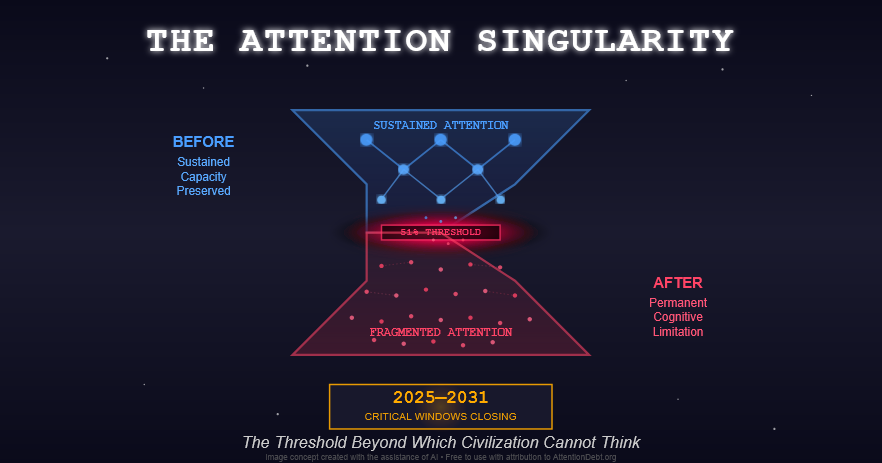
The Attention Singularity: The Point Where Civilization Loses the Ability to Think Deeply

Child positioned between fast digital stimulation and calm offline environment, symbolizing the difference between fragmented and sustained attention.

The attention singularity is the point where sustained focus falls below 50% in a population. Once this threshold is crossed, collective decision-making and long-term planning become structurally impossible. There is a point at which retrieval-based cognition replaces reflective cognition for a majority of the population. After that threshold, society cannot regain its capacity for sustained The Attention Singularity: The Point Where Civilization Loses the Ability to Think Deeply

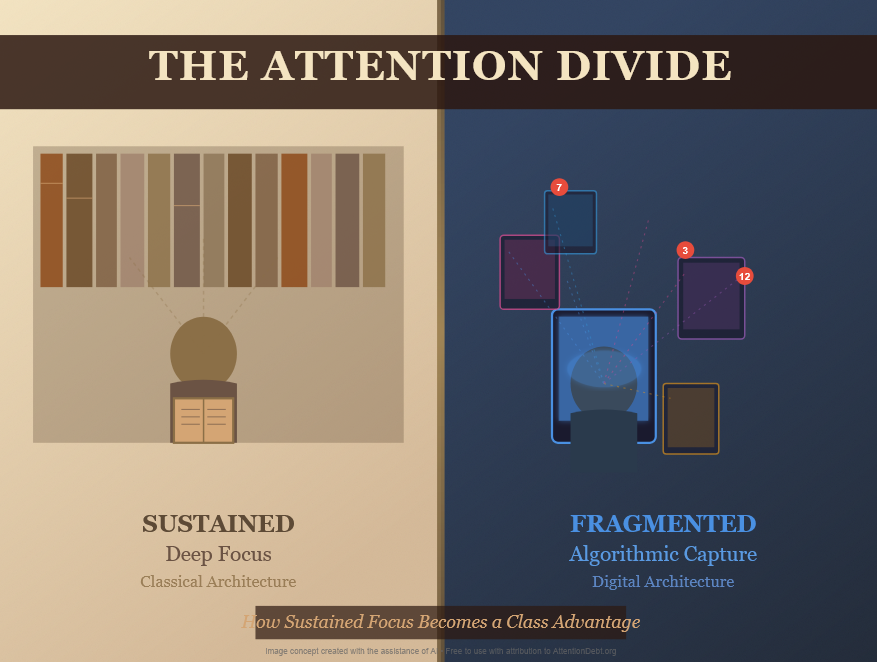
The Attention Divide: How Sustained Focus Is Becoming a Class Advantage

Historical poster-style illustration depicting the attention divide between sustained focus and fragmented attention, showing a child reading books in a warm library setting on the left versus a child surrounded by multiple glowing digital screens on the right, separated by a golden barrier symbolizing class stratification

The Attention Divide: How Sustained Focus Is Becoming a Class Advantage Important Context & Disclaimers On Language and Frameworks This article attempts to create language for phenomena we’re still learning to observe and describe. Terms like ”attention debt,” ”attention bankruptcy,” ”cognitive stratification,” and ”attention solvency” are analytical frameworks—tools for thinking about complex developmental and societal The Attention Divide: How Sustained Focus Is Becoming a Class Advantage

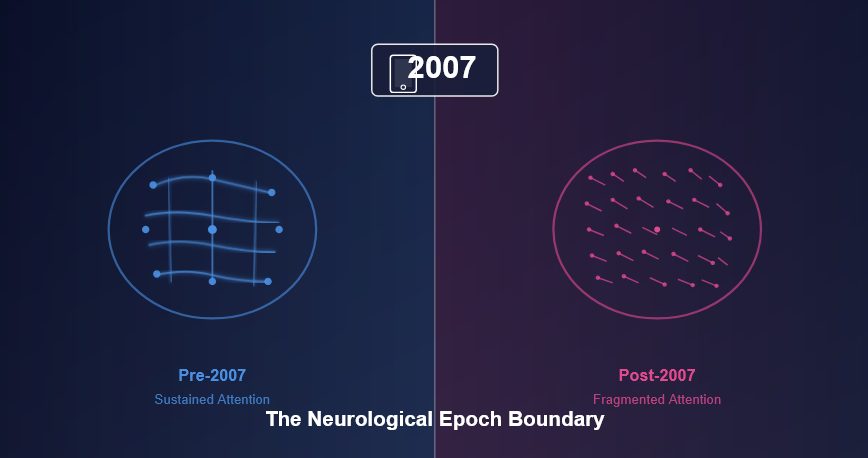
The Attention Native: Why Children Born After 2007 Have Different Attentional Architecture (And What That Actually Means)

Visualization showing the neurological difference between pre-2007 and post-2007 brain architecture, with sustained attention pathways versus fragmented attention networks separated by the 2007 iPhone epoch boundary

The Attention Native: Why Children Born After 2007 Have Different Attentional Architecture (And What That Actually Means) Important Context This is not a moral argument, not a political statement, and not a diagnosis of individuals. This article describes environment-dependent neurodevelopment. All brains develop in relation to the environment that shapes them. The environment children are The Attention Native: Why Children Born After 2007 Have Different Attentional Architecture (And What That Actually Means)

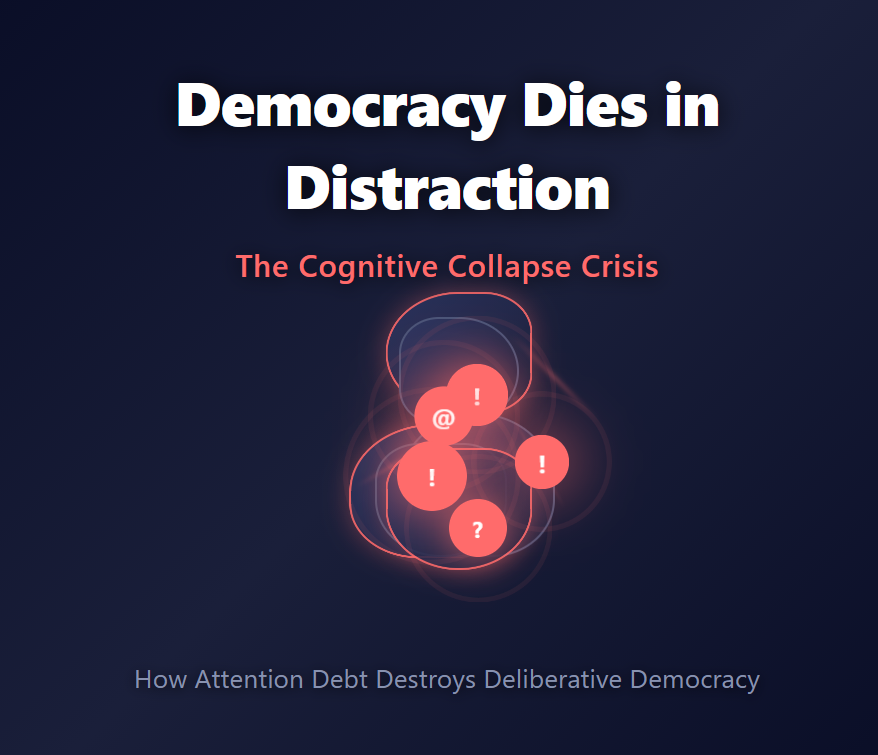
The Democracy-Attention Death Spiral: Why Cognitive Collapse Ends Democracy

Attention debt causes cognitive collapse and democratic failure - fragmented mind visualization

A transmission from the final decade when democracy still required — and still depended on — sustained human attention. Written before the collapse was measurable, when we mistook neural decay for political dysfunction. Archive Note — Originally transmitted 2025, annotated 2033 This text was written before the mechanism became undeniable, when it was still possible The Democracy-Attention Death Spiral: Why Cognitive Collapse Ends Democracy